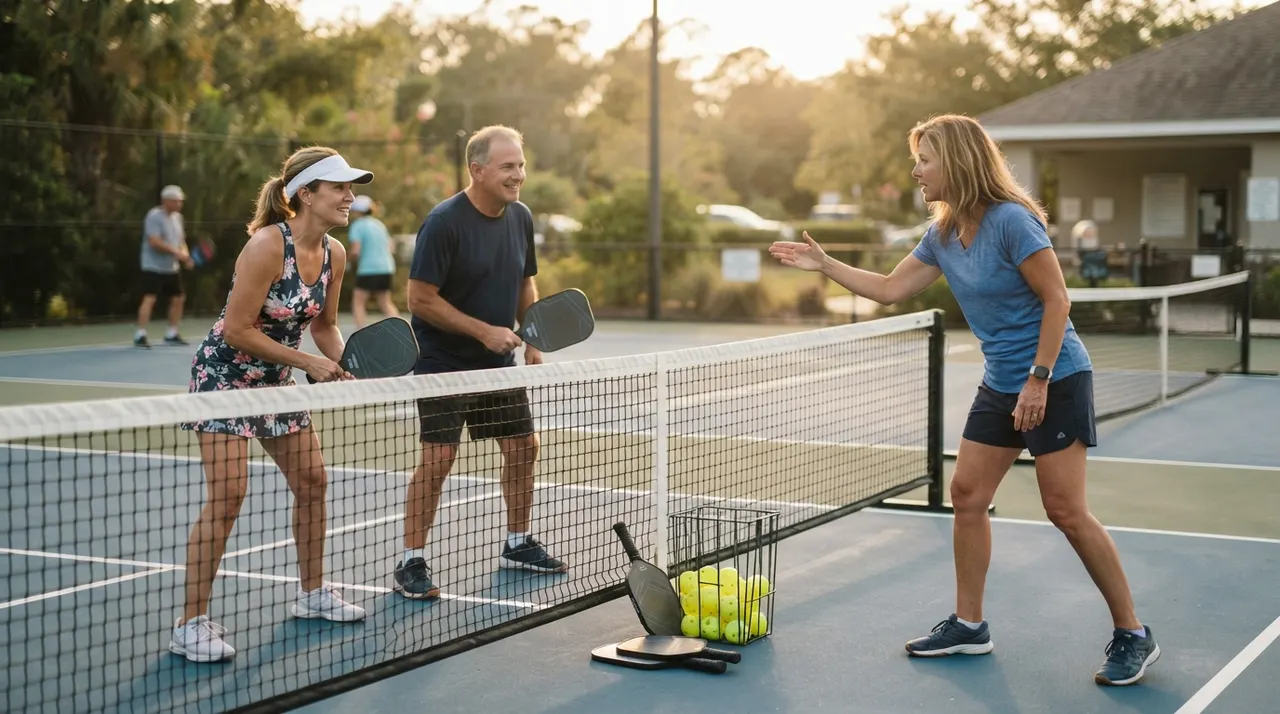
How to keep score in pickleball doubles, explained clearly — the three-number call, first and second server, even/odd side switching, and a full worked example.
Learning how to keep score in pickleball doubles is the single thing that trips up almost every new player — the shots come easily, but the three-number call sounds like a secret code for weeks. It isn't. Once you understand what each number means and the one even/odd trick that keeps you oriented, doubles scoring goes from baffling to automatic. Here it is, taught the way we teach it in a first lesson, with a full worked example at the end.
TL;DR — pickleball doubles scoring in six lines
- Only the serving team can score a point.
- Games go to 11, win by 2.
- Before every serve you call three numbers: your score, their score, and whether you're server 1 or server 2.
- Both partners get to serve before the ball goes to the other team — except the very first service turn of the game, which gets only one server.
- Serve from the RIGHT side when your team's score is EVEN, the LEFT side when it's ODD.
- When your team wins a point, you and your partner switch sides; when you lose the rally, you stay put.
The three numbers, decoded
The call you hear before every serve — something like "4-2-1" — is always three numbers in the same order. The first is your team's score. The second is the opposing team's score. The third is whether you are your team's first server or second server for this service turn (1 or 2). So "4-2-1" means: my team has 4, your team has 2, and I'm the first server. Say it out loud, every time, before you serve — it's not a formality, it's how everyone on the court (including you) keeps track.
First server, second server, and 'side out'
In doubles, both partners serve before the serve passes to the other team. You keep serving — scoring points and switching sides with your partner each time you win one — until your team loses a rally. That's the first server done; now your partner serves (this is when the third number becomes 2). When the second server also loses a rally, it's a "side out": the serve goes to the other team. The one famous exception is the very start of the game — the first serving team of the whole match gets only ONE server, so their opening call is "0-0-2," meaning that lone server is treated as the second server. It's a head-start rule to keep the first team from running away with it.
Nobody memorizes doubles scoring — they anchor to one rule (even score, serve from the right) and rebuild the rest of the call from there mid-game. Learn that one, and you're never truly lost.
The even/odd trick that keeps you oriented
Here's the anchor that rescues you when you lose the thread: your serving position is tied to your team's score. When your team's score is EVEN (0, 2, 4...), the player who started the game on the right serves from the right. When it's ODD, they'll be on the left. Because you and your partner switch sides only when you score, your correct side is always determined by whether your score is even or odd. If you ever forget where to stand, check your team's score — even means right, odd means left. That one relationship silently keeps two partners correctly positioned for a whole game.
A full worked example
- Game starts. Team A serves first. Call: "0-0-2" — first team, one server only, serving from the right (score is even/zero).
- Team A wins the rally: 1-0. The server and partner switch sides; now serving from the left (odd score). Call before the next serve: "1-0-2."
- Team A loses the next rally. Because they only had one server to start, it's an immediate side out — serve goes to Team B. Team B's first server calls "0-1-1" (their 0, A's 1, first server).
- Team B wins two points (1-1, then 2-1), switching sides each time, then loses a rally. Now Team B's SECOND server takes over: "2-1-2."
- Team B's second server loses the next rally — side out back to Team A, who now get both servers. Their first server calls "1-2-1" (A's score is 1, so serve from the left).
- Play continues this way to 11. If it reaches 10-10, keep going: you must win by 2, so 12-10, 13-11, and so on.
How to keep score in pickleball doubles FAQ
What do the three numbers mean in pickleball scoring?
Your team's score, the other team's score, and whether you're the first or second server (1 or 2). You call all three out loud before every serve — e.g. "5-3-2" means your team 5, theirs 3, and you're the second server.
Why does the game start at 0-0-2?
The first serving team of the game gets only one server before handing the ball over, to stop them gaining an unfair opening advantage. That single server is designated as the second server, so the opening call is "0-0-2."
Which side do you serve from in pickleball doubles?
The right side when your team's score is even, the left when it's odd. Since partners switch sides only when they win a point, your team's score always tells you where each of you should be standing.
When do partners switch sides in doubles?
You and your partner switch sides each time your team wins a rally while serving. If you lose the rally, you stay where you are — only the serving team moves, and only when it scores.
How many points do you need to win a pickleball game?
11 points, but you must win by 2. At 10-10 the game continues until one team leads by two — 12-10, 13-11, and so on. Tournament games are sometimes played to 15 or 21, but recreational games are almost always to 11.
Reading scoring and doing it live are two different things — you'll lose track in your first few games, and so did everyone else. If the rest of the rules are still fuzzy, start with our plain-English pickleball rules for beginners. And the fastest way to make scoring click is to have a coach call it out loud with you until it's automatic — that's exactly week one of our beginner Learn-to-Play program, where you'll be scoring real games without help by the end.
References
- USA Pickleball — Essential Rules Summary (scoring & serving sequence)
- Pickleball Canada — Basic Rules (doubles scoring, first/second server)
This article is general educational information, not professional, medical, or purchasing advice. External links are provided for reference; Vaughan Pickleball Tutor is not affiliated with and does not endorse any third-party brand or organization listed.